Tuesday, April 8, 2008

Ghost World

click on image to see preview

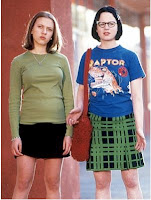
Ghost World was made released in 2001 as a collaboration of Daniel Clowes and Terry Zwiggof. Daniel Clowes had written 'Ghost World' as a comic book which was later made into the film. He co-wrote the script alongside Zwiggof, who directed the film. Daniel Clowes also wrote the comic 'Art School Confidential' which was later made into a film of the same title. They made the film with an aim at trying to depict daily life of the so-called "social outcasts." The film doesn't really have climactic movements. Watching it makes you kinda feel like you're just following these girls around and seeing what they do with their time. The film's actors are relatively known, but mostly in the independent world. The film stars Thora Birch (American Beauty) plays the lead alongside Scarlett Johansson (Lost in Translation) with Steve Buscemi (Reservoir Dogs)in the lead male role.
The films centers around Enid and Rebecca, two teenage girls that have just graduated high school and are in the process of "growing up." They plan on moving in together and are trying to figure out what they're going to do with their lives. Rebecca is a little more subtle and has a steady job and is psyched to get stuff for her new apartment. Enid is a little lost and not too sure what she wants. To bide their time, they bother their friend at the local gas station about getting rides around town and make up wild stories about strangers and follow them. To amuse themselves, they respond to an ad in the personal section of the paper and hide out, watching their nerdy victim as he embarrasses himself waiting for a date that doesn't exist. They then follow him to his house and visit him at his rummage sale on a later day. This man, Seymour, becomes Enid's new interest, eventually developing on a very personal level. The more Seymour and Enid's nerdy relationship grows, the more Enid and Rebecca part ways.
The film is very edgy in the sense that you sort of see into the minds of the "strange" people that normally stand out when you walk into a crowded place. Enid has a very rebellious character just basically doing whatever she wants, whenever she wants. Rebecca is more laid back is more willing to conform and enjoy herself. Seymour is about forty and is a total geek who cuts himself off socially and spends his time collecting old blues records. I also thought this film was very independent-esque in the the sense that it relies more on dialogue and the girls' quirky characters rather than an action-oriented plot line.

Juno


For my second lived post of the semester I will be discussing the movie Juno. It is actually really interesting to me that this film is classified as independent. First of all it seems that for some reason to me anyway a film should be independent for more than just the reason of being financially made by ones self, with no help from a big studio. Even if this film had no help from a big studio it is filled with established Hollywood stars and should therefore not really be classified as independent, because, I am sure, that they didn't have as much trouble making it as one of us in film school would have. The director is an already established person in Hollywood so making this movie was probably not very difficult for him. I am sure he had the support of most if not all of the actors and I am also sure that money wasn't that big a deal anyway seeing as he is a famous actor in Hollywood.

I am not trying to diminish the films integrity or deny that it is a good piece of work all I am saying is that the system for making movies in our society is a little one sided. People that have the money or the connections already in place seem to make all of these movies and want to advertise them as independent films as to say they are on the same page with El Mariachi for example. Rodriguez was a nobody and had no money and made that film what it is today. He is a true inspiration for young filmmakers that are trying to make it in the film world. It was an excellent movie dont get me wrong, but when it comes right down to it, it just seems like the system sort of sucks.

Enough of my ranting and raving, I think that one thing that stood out the most about this film though was its acting, it was up for some academy awards and I guess it deserved to be. I was really impressed by the leads acting as well as some of the supports like Jennifer Garner. It sort of surprised me that she was in here because she doesn't really seem like the person to do an independent, lower budget film. She seems like she would want the bigger paycheck in the end, but I suppose I could be wrong too.

Monday, April 7, 2008

Beloit Film Festival


For my blog lived experience, I want to write about the Beloit Film Festival my buddy entered in this past summer. Every summer my buddy and I mess around with shooting short films with our friends. Every summer we write and then create them, but never think about submitting them to a film festival. We would think that our films were not professional enough to submit and no one would take them seriously. Well this past summer I unfortunately could not work with him this summer because I have becomes very busy in my own life. He wrote and directed a film called The Capability. It is a twenty three minute short film about three guys and one has the capability to kill. They get put into a situation and in the end you find out what one has the capability to kill. It is a great short film especially being made on no budget with four guys and a camera.

The end of the summer came and my buddy called to tell me how everything went and also decided to tell me he entered this film into the Beloit Film Festival. He was like, “I probably won’t get it in, but it is worth a shot isn’t it?” I said yes of course and wished him good luck. A couple weeks went by and I get a voice mail from my excited friend saying that they accepted his short film into the festival. This festival is by no means at all small, last year the main movie that won starred Katherine Heigel from the movie Knocked Up. He asked me if I would go with him to it and I said I would not miss it.

I feel this whole story relates with what we are learning in American Independent Cinema. The way my friend got into the festival, is like every other indie filmmaker in the world. They might work with larger budgets and better equipment, but he is starting off in the right direction. He also kept a journal like Robert Rodriguez did when he was filming El Mariachi. He explained all the troubles he went through with lighting and places to shoot. He also used actors that are not known at all, which are his friends. His production budget really just included food and mine dv tapes. His friends did not ask for money and he had no one assisting him because I could not help out. This whole procedure shows the independent filmmaker versus the Hollywood production route that was broken down in class for us. I feel it is a great example that you can start off at smaller festivals and work your way up to bigger ones.

In the end he did not win a prize, but being accepted to his first film festival at the age of 19 was winning enough. He was happy with the audience’s response to his movie. They laughed when he wanted them to laugh and jumped when he wanted them to jump. He also felt the Q&A was very fulfilling because a lot of people were interested in his topic and asked him questions. It shows that you don’t need a blockbuster, Hollywood production to start off in this industry. Bryan Pechacek

Friday, April 4, 2008

On Southland Tales

Click Image for Trailer.

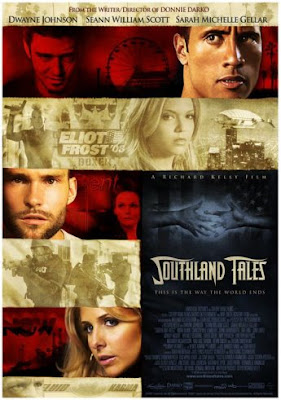
Southland Tales is writer/director Richard Kelly's second film, his first being Donnie Darko. Southland Tales is very much in the vein of Independent cinema both in production, story, and visuals. Production was the film had a rough road, shooting was delayed a year until the full cast was in place and funding came after it's festival release. Cherry Road Films funded the initial production for around 15-17 million, which is quite a lot for an independent, but due to the cult following and video release success of Donnie Darko, Kelly was in a prime spot to get better funding for Southland Tales. The films initial edit was 160 minutes long and once it hit festivals it was purchased by Sony Pictures. Kelly and Sony negotiated a deal where more funding for post production would be granted if the film's length was cut. Once more funding came in, Kelly added 90 visual effects and cut the film by 20-25 minutes. The film itself got horrible reviews, especially at the Cannes film festival and it only brought in around $350,000 at the box office. One could say Southland Tales was a hugely independent failure, but don't underestimate the complexities of Kelly film making abilities.

Visually the film was some what traditional in terms, but what was interesting was the use of flat colors within the film. I think Kelly tends to keep his images very dismal and gray, which fits the mood of this film, which puts the present day US in a doomsday situation. But where this films independence really shines is in it's content. Kelly has a unique voice in film and his stories are unique and very complex in nature. Donnie Darko is a prime example, if anyone had visited the website for the film it is very detailed in it's background stories and outlining stories. Southland Tales is the same way, it is actually only three parts of a six part story, the other three were written into books and were going to be released monthly up until the release of the film, this however did not work out. The film starts with the start of World War III, and the US has now blocked off state boarders and citizens need state visa to enter other states. Extremist groups develop and radical political parties and developed. The story centers around an action film actor who suffers memory lose who has ties to right winged political members. He is being sought out by the US and kept tabs on by a Neo-Marxist group. The film is narrated by an Iraq veteran who spins the tale with among other things quotes from the book of Revelation. The film is a satirical fantastical story critiquing ideas of religion and post 9/11 America. Kelly describes it as "creating a piece of science fiction that's about a really important problem we're facing, about civil liberties and homeland security and needing to sustain both those things and balance them." He also sites the films inspirations were the films Kiss Me Deadly, Pulp Fiction, Brazil, and DR. Strangelove. I would recommend this film to people who liked Donnie Darko because it's in the same nature of that film, a world on the brink of destruction with science fiction themes and rips in time. Although not critically of financially successful, the film is worth seeing and Kelly again displays a unique and independent way to weave a good story. Let's just hope Richard Kelly gets the praise he deserves as an American independent film maker.


When Robert Rodriguez first conceived of El Mariachi, he intended to release the film direct to the Spanish video market. By his account, he really did not expect the film to be successful, at least not in the way that it was. His intention was to make it a trilogy, using the three films to practice his filmmaking. To his purported surprise, the film became wildly successful. When columbia initially picked up the distribution rights there was discussion on wether or not the film should be remade with a larger budget with Antonio Banderas starring as the guitar player. Columbia eventually decided they wanted to cash in quick and release the original version of El Mariachi as well as make a Hollywood film using the same character.

Eventually Rodriguez would go on to complete his trilogy. It becomes an interesting study of film making because each film would have a bigger budget, but through it all Rodriguez maintained his steadfast adherence to maximizing his budget by staying cheap. Rodriguez made El Mariachi for $7,000 while trying to make it look like a $7 million dollar movie and Desperado while trying to make it look like a 30 million dollar movie. He finished off by making Once Upon a Time in Mexico for around 30 million.

Even though the movies get successively more expensive I Still always get the feeling the I am seeing more on the screen then was spent for the film. 30 million dollars is a lot of money but it is still relatively cheap for big budget hollywood action movies. Movies similar to Once Upon a Time in Mexico often spend between 50 and 60 million and don't look that much better or even different (at least to my eye) than that film.

Personally watching the films with the commentary or listening to Rodriguez's 10 minute School series provides a revealing example of the way the independent spirit of film making can be applied to Hollywood movies with results that are at once unique and refreshing AND familiar and digestible. Rodriguez ways of maximizing the budget is as much a style in and of itself and are the reasons that he is valuable to the art not just for his films but his ideas and theories of film making.

Saw


While skimming around to find a film to watch or one I’ve already seen for this lived experience blog I ran into the movie Saw so I decided I would watch it again to give myself a refresher on it. At first I was confused because I thought for sure Saw wasn’t an independent film due to how well it was put together but sure enough it was first shown at the Sundance Film Festival in 2004. Some of the actors in it are Leigh Whannell, Cary Elwes, Danny Glover, and Dina Meyer to name a few. The original cut that was shown at Sundance was rated NC-17 but for releases in theaters it was edited a little to drop it down to an R rating. There were only a few changes made to drop it down which cut the length of the movie by only about a minute or so. The film was made in only 18 days, which if you’ve seen the movie it doesn’t seem like it was possible. For those who haven’t seen the movie before I’m going to first say if you’re squeamish don’t watch this movie, there is a lot of blood and gore involved in it. There are also many parts that would seem like torture basically to the victims who are trying to save their own lives, ending with some ultimately ending their own lives. The plot starts out with two men wake up at opposite ends of a run down bathroom chained to some pipes with a dead man lying in the middle with a tape recorder and a handgun. Both men have tapes that explain what’s going on. What it boils down to is one of the men must kill the other or his wife and kids will die. Some flashbacks of other “death-puzzles,” I guess you could put it, are thrown into the movie to show what other traps this psycho who is nicknamed Jigsaw, due to his practice of cutting up the victims skin into jigsaw puzzle pieces, has planned out before. Jigsaw doesn’t actually ever kill his victims first hand. He either lets them die from the people not completing the sick and twisted games he plays or the victims end up killing themselves. There are many twists and turns in this horror flick that will keep you watching up until the very end. For people who love horror films, especially the bloody gory kinds I’d recommend this movie and all of the other Saw films to watch.
-Dustin Fletcher

On Welcome to the Dollhouse

Readings:
Salon.com interview with Todd Solondz

Geoff King, "Industry" from American Independent Cinema. Bloomington: Indiana University Press, 2005. pgs. 11-57.

Questions:

1. In the salon.com interview, Solondz talks about the lack of cinematic representations of adolescence. Do you think that Welcome to the Dollhouse offers the "realistic" representation that Solondz was aiming for? Why or why not?

2. The King reading provides a comprehensive overview of the industry framework within which independent cinema emerged. According to King, in what ways did the major studios' involvement in the sector in the 1990s affect independent film production?